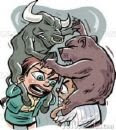
Hello, I personally think there should be a correction on tuesday.... to understand market correction, good to read this article again before proceeding.... hehe... :P
http://survivingstockmarket.blogspot.com/2007/10/volatility-vs-severe-acute-distribution.html
Now, why do i say there might be a correction? why would i think there will be one in the first place...
well, on Friday, actually on my side, i think our CI is moving on a healthy style... so am really expecting a good day, at least at the early session on Monday.... but.... walau eh... on the friday night itself, the DJI made almost a 400 point drop.... this itself is severe enough to make any healing wound to burst.... so i personally think Monday's drop is not due to our intrinsic factor.... it is more of a intermarket effect... so this made me to believe tat a correction should have happened on tuesday...
unfortunately, the whole regional market decides to bleed some more.... when i look at our intraday CI movement, and compared it with our neighbours, i notice tat we are actually performing quite well. which leads me to believe that recovery is indeed in place, only might be stalled or masked.... so i am actually putting quite high expectations on wednesday... :)
and i do hope tat it will not let me down...
but let me emphasis again, i am not saying that there will be a major change in the trend, when i say recovery, it just means tat there should be an upmove or an up swing.... wether or not it is enough to make a trend change, will still depends....
Regards & Good luck!
Showing posts with label Basic knowledge. Show all posts
Showing posts with label Basic knowledge. Show all posts
Wednesday, June 11, 2008

Wednesday, April 23, 2008
How to use Volume

How to use volumes…. This itself is long enough to write a few articles… :P first of all, how to use volumes depends on what method you are adapting to…. to start from basic, volume is formed when transaction is done… every transaction or every volume means an agreement of price between buyers and sellers…. Volume is like and indicator for the sustainability of trend…. To make it simple, it is like fuel for the flame… the flame represents the trend, no matter up or down… so, if you see volume dying down, it shows signs of dying flame too…. and vice versa… simple? :P
Now, homework….
1) Are the statements correct?
a. Low volume equals illiquid.
b. Low volume equals price is about to drop.
2) What is true low volume and what is relative low volume? What is the significance?
Ok, lets go a bit deeper, if we are using trends or phases… how do we incorporate volume into them? Basically, we can generally divide the trend into three types or phases:
3) Uptrend
4) Downtrend / Distribution
5) Range bound
How does volume come in? Well, as stated above, when we see price moving uptrend, a healthy one will be accompanied with increasing volume because this means more people agree and supports the increasing price… so we can say it is sustainable…. and vice versa…
How about range bound? during range bound, volume is also normally in range… why? Because less transactions involved… now, towards the end of range, volume will pick up… because there will be more and more people involved and more transactions are being done… this is called public participation…
Homework:
1) Does public participation or volume picking means that uptrend is next?
2) Revise a bit on supply Vs demand.
Ok, stop here first, leave the deeper stuff for later… :P do post your answers and questions if you don’t understand or require further information…
Regards and happy learning
Now, homework….
1) Are the statements correct?
a. Low volume equals illiquid.
b. Low volume equals price is about to drop.
2) What is true low volume and what is relative low volume? What is the significance?
Ok, lets go a bit deeper, if we are using trends or phases… how do we incorporate volume into them? Basically, we can generally divide the trend into three types or phases:
3) Uptrend
4) Downtrend / Distribution
5) Range bound
How does volume come in? Well, as stated above, when we see price moving uptrend, a healthy one will be accompanied with increasing volume because this means more people agree and supports the increasing price… so we can say it is sustainable…. and vice versa…
How about range bound? during range bound, volume is also normally in range… why? Because less transactions involved… now, towards the end of range, volume will pick up… because there will be more and more people involved and more transactions are being done… this is called public participation…
Homework:
1) Does public participation or volume picking means that uptrend is next?
2) Revise a bit on supply Vs demand.
Ok, stop here first, leave the deeper stuff for later… :P do post your answers and questions if you don’t understand or require further information…
Regards and happy learning
Wednesday, April 16, 2008
What is KLCI?

Hello,
When we talk about the market, generally, we refer to the KLCI... however, do we really know what is KLCI, how is it calculated, what determine its movements and how the movements affect other counters? well, this may be very basic to most people, but i do think it is important to know the basics first so that we can understand the complicated.... :)
1) KLCI is calculated with this formula:
Current aggregate Market Capitalisation x 100 base
_____________________________________
Aggregate Market Capitalisation
2) wat are the counters tat is used to calculate? the answer is in http://%20www.bursamalaysia.co%20m/website/bm/%20market_information/%20index_components.htm%20l
so, this also means tat, the KLCI does not represent the whole market, because not all counters are used to calculate it... some would prefer to use market breath... but then again, for TA readers, so far, i have not seen a chart tat uses market breadth.... wat to say use the beloved indicators on it? hehe.... tat is why, the closest you can get might still be the CI when you want to use TA... hehe... :P
and the CI is determined by the price and not the other way around... (questionable) that statement is theorically correct, but practical wise, it depends... i will explain more on this in the next article.... or else this one will be very long... hehe... :P
Regards
Saturday, April 5, 2008
Fundamental Vs Technical

Actually there have been quite a lot of arguements on which is better... but if you ask me, i think both are good methods. it just depends on the user's style and preference... :)
Anyway, what is the difference between the two? Well, FA looks at balance sheets and annual reports to make their picks. TA looks at the charts to make their picks.
actually, both have some very different perspective on "expensive" and "cheap"... hence time to buy and when not to buy...
if you were to imagine stock is a product, you might be able to understand these methods better. FA uses annual reports to determine the current and future potential of a company and sets a value for it... for example, by using annual reports, FA defines a value or the price the stocks is worth.... either now or in future (investments). so when the current price is higher than wat they value now or the future potential, they consider it as expensive... but if the current price is below their value, they call it cheap or discounted... so it will mean time to buy... that is why you find investors using FA averaging down...
TA on the other hand do not really focus on the price itself or the potential of the company, but rather on the balance between supply and demand. no matter how good or how bad a company is, there will be a time to buy and time to avoid... TA buys when there is demand for the stocks... or when the demand is starting to exceed the supply... which also means tat the price is going up... so, wat is expensive and what is cheap for TA users? hehe...
Basically, expensive is the price when the demand is getting lower, which is when the price will start to drop... and cheap when the demand starts to pick up... so, TA actually averages up and dont average down (normally). because as i said, it is about supply and demand, when price go down, it means the demand is less, so TA will avoid such stocks...
to sum up, FA values a point or a range of a price tat they think the stock is worth, anything more is expensive and less is cheap...
TA tracks a movement of price, so you can say there is no cheap or expensive, only demand vs supply... buy when there is demand...So, this is why investors using FA averages down but traders using TA dont...
Regards...
Anyway, what is the difference between the two? Well, FA looks at balance sheets and annual reports to make their picks. TA looks at the charts to make their picks.
actually, both have some very different perspective on "expensive" and "cheap"... hence time to buy and when not to buy...
if you were to imagine stock is a product, you might be able to understand these methods better. FA uses annual reports to determine the current and future potential of a company and sets a value for it... for example, by using annual reports, FA defines a value or the price the stocks is worth.... either now or in future (investments). so when the current price is higher than wat they value now or the future potential, they consider it as expensive... but if the current price is below their value, they call it cheap or discounted... so it will mean time to buy... that is why you find investors using FA averaging down...
TA on the other hand do not really focus on the price itself or the potential of the company, but rather on the balance between supply and demand. no matter how good or how bad a company is, there will be a time to buy and time to avoid... TA buys when there is demand for the stocks... or when the demand is starting to exceed the supply... which also means tat the price is going up... so, wat is expensive and what is cheap for TA users? hehe...
Basically, expensive is the price when the demand is getting lower, which is when the price will start to drop... and cheap when the demand starts to pick up... so, TA actually averages up and dont average down (normally). because as i said, it is about supply and demand, when price go down, it means the demand is less, so TA will avoid such stocks...
to sum up, FA values a point or a range of a price tat they think the stock is worth, anything more is expensive and less is cheap...
TA tracks a movement of price, so you can say there is no cheap or expensive, only demand vs supply... buy when there is demand...So, this is why investors using FA averages down but traders using TA dont...
Regards...
Sunday, January 27, 2008
Overbought and oversold

Hello, Recently these terms becomes very frequently heard... haha... this is expected as these indicators will be showed very actively on most charts due to the price movements...
So, maybe it is good to discuss a little about the functions and the limittations...
first of all, wat affects the price of stocks? i believe it would be the balance between supply and demand...
based on this, wat is oversold? meaning something is aggressively being sold... so the supply will be more while the demand for it is low... wat does this mean? there is too much products circulating and people are not willing or will not have to bid for the products with a higher price... so, the price will drop... and the opposite stands for overbought...
this is also why people depending highly on this indicator will buy when the stock is being oversold and sell when the stock is being overbought.
however, how dependable are these indicators? well, let us look at the pros and cons... the dependability will also depend a lot on which phase or trend the stock is in... wether it is on an uptrend, downtrend or range bound... why do i say so? there are some interesting points worth looking into...
if you believe tat overbought means time to sell and oversold means time to buy, let me ask you, how can a stock go into or continue on an uptrend if it is no high demand over supply? how can the price continue or start to go up if it is not being overbought? :)
how can a downtrend start or being kept if it is not being oversold?
this is also why the phase or trend of the stock is so crucial in determining how dependable this indicator is... hehe...
i do not use indicators, but if you insist on depending on this indicator, be aware of the phase, it is a lot more dependable when the stock is in range movements and highly dangerous if used solely on trending phase...
most indicators are not suitable to be used alone... and this happens to be high on the list... so, maybe it is safer to use this indicator to find stocks to be put into your radar while using other more fine tuned method or indicator to time the entry and exit point... :)
So, maybe it is good to discuss a little about the functions and the limittations...
first of all, wat affects the price of stocks? i believe it would be the balance between supply and demand...
based on this, wat is oversold? meaning something is aggressively being sold... so the supply will be more while the demand for it is low... wat does this mean? there is too much products circulating and people are not willing or will not have to bid for the products with a higher price... so, the price will drop... and the opposite stands for overbought...
this is also why people depending highly on this indicator will buy when the stock is being oversold and sell when the stock is being overbought.
however, how dependable are these indicators? well, let us look at the pros and cons... the dependability will also depend a lot on which phase or trend the stock is in... wether it is on an uptrend, downtrend or range bound... why do i say so? there are some interesting points worth looking into...
if you believe tat overbought means time to sell and oversold means time to buy, let me ask you, how can a stock go into or continue on an uptrend if it is no high demand over supply? how can the price continue or start to go up if it is not being overbought? :)
how can a downtrend start or being kept if it is not being oversold?
this is also why the phase or trend of the stock is so crucial in determining how dependable this indicator is... hehe...
i do not use indicators, but if you insist on depending on this indicator, be aware of the phase, it is a lot more dependable when the stock is in range movements and highly dangerous if used solely on trending phase...
most indicators are not suitable to be used alone... and this happens to be high on the list... so, maybe it is safer to use this indicator to find stocks to be put into your radar while using other more fine tuned method or indicator to time the entry and exit point... :)
Tuesday, October 30, 2007
Blue chips? Potato chips? or... ?
Also my article posted in www.talkandshare.com
Erm, this may be a little late cos was a little busy last few days, but still can use this for future reference... :)
Before i proceed, it is better if you have read this posting first...
http://www.talkandshare.com/index.php/ Technical-Analysis/378-Volatility-Vs- Severe-acute-distribution-Crash......- P.html
i think it is important to know wat kind of market movement it was before you proceed further.... Lets say, you have identitified it to be a volatile market... now wat?
Many of you will be asking wat counters should we buy next when the KLCI moves back up... One of the best method would be to use TA... if tat happens to be not at your finger tips yet.... well, you could still buy with the risk reward ratio method.... or also called, calculated risk... hehe....
why i say it is important to identitify the market sentiment first? well, this is so tat you can make sure you have the rewards favouring you... in the posting on volatile market, i mentioned tat the market movement will be down then back up.... so when it makes a dip down, you will expect it to move back up in a volatile market... so, here is the part tat u can use to pick your stocks....
when we say the market dips, we generally means the KLCI dips... a point to take note about the KLCI is tat, it does not represent the whole market, it does not represent every single counter out there... KLCI is calculated based on some calculations of the index linked counters.... so, wat is the significant here?
Well, when the KLCI dips, wat we can say is tat it shows most of the index linked counters would have diped... so, if the KLCI is moving back up or is showing recovery... it also literally means those index counters are also following... and since they have made a dip and is moving back up (correction), you can also say tat they are on a bargain price, so your risk will be reduced and the rewards will be increased... so, this is when the risk reward ratio will be favoring you...
Btw, since a lot of these index linked counters also happens to be blue chips, tat is why after the market dips in the volatile market, the blue chips will be the ones tat is climbing first... :)
but of course there are other reasons such as FA, investors will also pick them up at bargain prices... :P
So, to use this risk reward ratio properly, you should make sure of a few things:
1) make sure it is a volatile market and NOT a crashing market or recession...
2) the market is moving back up or recovering...
3) try to identitify index linked counters tat was battered due to the panic selldown and not due to its internal fundamental problems...
4) if money is on your side, you may look into blue chips tat are index linked and was hit by panic sell.... :)
So, Blue Chips anyone? :)
Regards & good luck!
Erm, this may be a little late cos was a little busy last few days, but still can use this for future reference... :)
Before i proceed, it is better if you have read this posting first...
http://www.talkandshare.com/index.php/ Technical-Analysis/378-Volatility-Vs- Severe-acute-distribution-Crash......- P.html
i think it is important to know wat kind of market movement it was before you proceed further.... Lets say, you have identitified it to be a volatile market... now wat?
Many of you will be asking wat counters should we buy next when the KLCI moves back up... One of the best method would be to use TA... if tat happens to be not at your finger tips yet.... well, you could still buy with the risk reward ratio method.... or also called, calculated risk... hehe....
why i say it is important to identitify the market sentiment first? well, this is so tat you can make sure you have the rewards favouring you... in the posting on volatile market, i mentioned tat the market movement will be down then back up.... so when it makes a dip down, you will expect it to move back up in a volatile market... so, here is the part tat u can use to pick your stocks....
when we say the market dips, we generally means the KLCI dips... a point to take note about the KLCI is tat, it does not represent the whole market, it does not represent every single counter out there... KLCI is calculated based on some calculations of the index linked counters.... so, wat is the significant here?
Well, when the KLCI dips, wat we can say is tat it shows most of the index linked counters would have diped... so, if the KLCI is moving back up or is showing recovery... it also literally means those index counters are also following... and since they have made a dip and is moving back up (correction), you can also say tat they are on a bargain price, so your risk will be reduced and the rewards will be increased... so, this is when the risk reward ratio will be favoring you...
Btw, since a lot of these index linked counters also happens to be blue chips, tat is why after the market dips in the volatile market, the blue chips will be the ones tat is climbing first... :)
but of course there are other reasons such as FA, investors will also pick them up at bargain prices... :P
So, to use this risk reward ratio properly, you should make sure of a few things:
1) make sure it is a volatile market and NOT a crashing market or recession...
2) the market is moving back up or recovering...
3) try to identitify index linked counters tat was battered due to the panic selldown and not due to its internal fundamental problems...
4) if money is on your side, you may look into blue chips tat are index linked and was hit by panic sell.... :)
So, Blue Chips anyone? :)
Regards & good luck!
Sunday, April 22, 2007
Investor & Trader Similarity (Stock picking)

Ever since these two terms come into existence, there are arguments of which is the better among the two. Not only that, the list of differences among the two goes on and on. From time frame to stock picks to method of play, differences after differences were listed out. Pros and cons of the two schools of thought were being raised. But for now, let us put all the differences aside and let us look into the basis and find the similarities, shall we?
I’m sure some of you will be thinking,” Wow…. Wait a minute…. Investors and traders… Similarities?” Actually there are a few, not to mention that both are to make money through stocks… Agreed? Haha… This is one similarity already… How about that for a good start?
 Ok… Now we move on to some more serious ones…. Let us look at stock pick.Basically we say that investors and traders choose their stocks using different methods right? We say investors use Fundamental Analysis (FA) but traders uses Technical Analysis (TA), right? I’m sure you will agree if I say TA is made up of methods and tools to assess the interest or demand of the crowd towards a particular stock, by using MACD, EMA, RSI, etc. There is no doubt about that. This is what people call as the “Trader’s Style”, to buy a stock that is in demand. Now, investors actually also do the same thing, only the method they use is different. They use FA instead of TA. Why do I say that? Let us look into the basis of FA. FA is composed of areas like earnings, P/E ratio, ROE, NTA, etc. Actually, what are these methods measuring? It is to assess if the company is fundamentally strong. Correct? Now, why do investors choose fundamentally strong company? Have you ever wondered what are the real reasons behind that? Well, some say that they want to make sure the company is strong and is earning money. Well, that may be the reason, but actually investors uses FA to value a company’s performance in order that they will be able to select a company which will have price appreciation in the future because the demand for their stocks will increase. They believe that a fundamentally strong company will continue to become stronger and as time goes, the demand will always be on the hike. So, the price will go up together with the demand in the long run. Which means FA is the same as TA, they are used to decide if the stock will be in demand. And both investors and traders choose stocks that will be in demand... The only difference is the time frame… FA looks a lot further into the future.
So actually, there is a similarity when it comes to stock picking among investors and traders, both pick a company with the believe that the price of the counter will go up after their entry due to the increase in demand. There are a few other similarities that will be posted in the future… In the mean time, let us embrace both our investing and trading brothers and sisters in understanding and peace... hehe...
Wednesday, April 4, 2007
News and Effects
Good news! Good news! Good news about a particular counter is out everywhere.. newspapers, television.... You name it.... Maybe a large dividend, large project, huge profit... Anything.... Now, the basic instinct that we have is that when good news is out, the counter will sure have demand... When there is demand, the price will rise... So we jump in and grab the share by hook or by crook.. Whatever price also we are willing to pay as long as we get it fast. Then we can always sell at a higher price. This can be called, “Buy on news”. Is this concept true? Well, I would say the chance is 50%. Why do I say so? Let us investigate further....

Never forget that there is a group of people called speculators out there that will turn this logic upside down. They will cause the effect of “Sell on news”. They will snatch up the shares of a particular company before the news even came out. They will somehow get the information far earlier than anyone and they will start buying the shares at the lower price… Once the news is out, they will sell because by then the price would have risen and they take away the profit. Because speculators normally would grab a huge number of shares, so when they sell, they will cause the price to drop significantly.. And by then, everyone would panic and start their panic selling mode.. So the price will dip….
Case study: Stocks like Tebrau and UEMWRLD was rising tremendously before the announcement of the Nusajaya project.. By right, when the news actually came out, the shares should rise, but they took the other way instead….
So, “To buy, or not to buy?” Hehe… This is a tough question… That is why I don’t normally go for speculative stocks… But to know if there is already speculation in, you can tell by looking for clues. If the price of the stocks suddenly rises tremendously with super high volume for no particular reason, both from fundamental or technical point of view, it is a clue that something is fishy. Especially when there are rumours around about the company getting a huge project, etc… Be extra careful.. For those who have a huge taste and tolerance for risks and want to try out these stocks, you need to be very familiar with technical analysis… Make sure you enter early, place your stop loss plan… and FOLLOW it.. Try not to fall into the “last man on the block” syndrome.. That means, don’t be the last to enter or leave the building. Meaning don’t be the one to pay the highest but sell at the lowest price for the stock… Hehe…. These kind of stocks is like air filled balloons, they jet up when the air is released, but once all the air comes out, it makes a fast vertical fall…
Good luck and happy hunting…
Tuesday, March 27, 2007
Price have memories?
In my previous posting I mentioned that techical analysis is based on the believe that history repeats itself. Which means price have memories... It will remember the highest price, lowest price, volume and etc...
Does price really have memory? Logically, price is not a living being, so how can it have memory? But it does behave in a certain pattern... That is why you can predict (roughly) the support, resistance, trend or range... How is this possible? To understand this, we must first understand how is price determined and what influences it? In my previous posting http://survivingstockmarket.blogspot.com/2007/03/does-company-performance-affect-price.html , I mentioned that price is directly determined by the balance between the demand and supply... And these demands are made by human beings, who are alive and have memories and emotions. If price is to have memories, it will be the memories of these people...
As mentioned, technical analysis will sum up everything about the market into graphs to be interpreted. One basic concept about price is that everyone has an idea of how much the company is worth... So based on this perception, they will determine what is the most expensive price and what is the most bargain price... So, everytime the price for a particular stock is pushed up by demand, it will reach a particular price where most people think that it is the most expensive or the highest price offerable for the stock.. So, they will start selling and this is when supply overwhelms the demand and the price starts to drop. As the price drops, it will reach a price where most people thinks that it is the bargain price... So the demand will increase. When the demand overwhelms the supply, the price moves back up. And the cycle repeats itself...
So, whenever the price reaches the highest point, it will come down again and this point is called the resistance. When the price reaches the point when people starts to snatch it up again, the price will go back up, this is called the support.
Now, do you think the price have memories or people have memories?
Please take note... This is an oversimplified version... Further details will be posted in the future.. This posting is just the most basic concept... Do come back often to catch the details.. hehe...
Does price really have memory? Logically, price is not a living being, so how can it have memory? But it does behave in a certain pattern... That is why you can predict (roughly) the support, resistance, trend or range... How is this possible? To understand this, we must first understand how is price determined and what influences it? In my previous posting http://survivingstockmarket.blogspot.com/2007/03/does-company-performance-affect-price.html , I mentioned that price is directly determined by the balance between the demand and supply... And these demands are made by human beings, who are alive and have memories and emotions. If price is to have memories, it will be the memories of these people...
As mentioned, technical analysis will sum up everything about the market into graphs to be interpreted. One basic concept about price is that everyone has an idea of how much the company is worth... So based on this perception, they will determine what is the most expensive price and what is the most bargain price... So, everytime the price for a particular stock is pushed up by demand, it will reach a particular price where most people think that it is the most expensive or the highest price offerable for the stock.. So, they will start selling and this is when supply overwhelms the demand and the price starts to drop. As the price drops, it will reach a price where most people thinks that it is the bargain price... So the demand will increase. When the demand overwhelms the supply, the price moves back up. And the cycle repeats itself...
So, whenever the price reaches the highest point, it will come down again and this point is called the resistance. When the price reaches the point when people starts to snatch it up again, the price will go back up, this is called the support.
Now, do you think the price have memories or people have memories?
Please take note... This is an oversimplified version... Further details will be posted in the future.. This posting is just the most basic concept... Do come back often to catch the details.. hehe...
Saturday, March 24, 2007
Bulls, bears, hogs and sheeps
Hehe.. came across this phrase recently: "Bulls make money, bears make money but hogs get slaughtered."
Basically, in terms of buying and selling... a bull is someone who is buying - with the believe that prices will go up. A bear is someone who is selling - with the believe that prices will go down... The term bull and bear is derived from the way these animals defend themselves... A bull will use the horn in a upward strike, so it is like pushing the price up... A bear fights by striking things down with their paws, like pushing price down...
How about hogs? Hogs are described as greedy individuals.... They are tempted to buy shares which they cannot afford because of their greed to make quick cash... So if there is fluctuations in the price which happens very often, they get panic and they make bad decisions... That is why they always get slaughtered in the end... But if their bet is right, the shares they buy do go up... They will have the tendency to wait till the price go higher then they sell, but they often end up falling down the clift.... They may have their planned their moves in the begining.. Like hogs planned to go out and search for food... But greed always win and cloud their decisions and plans... In the end... They fall into the trap... That is how people use food to trap hogs.... Hehe...
Sheeps are great followers... They don't have to make decisions... All they need to do is to follow the trend or tips.... But one thing is for sure, the stock market is a very highly competitive place... People don't give away tips.... For they need to stay in the front in order to get the profits.. Real tips are not revealed, and those revealed are lousy tips... So, sheeps who get tips, get slaughtered as well... Those that follow trends always happen to be the last and the most foolish of the block... They always enter the uptrend late and when smart people are making their exit.... So, they alone ride the slide downhill....
So, which one are you? If you are the sheep or the hog, it is still not too late to upgrade yourself into a bull or bear... Hehe... Knowledge, skill and wisdom is the only thing that can transform you.... So, good luck.....
Basically, in terms of buying and selling... a bull is someone who is buying - with the believe that prices will go up. A bear is someone who is selling - with the believe that prices will go down... The term bull and bear is derived from the way these animals defend themselves... A bull will use the horn in a upward strike, so it is like pushing the price up... A bear fights by striking things down with their paws, like pushing price down...
How about hogs? Hogs are described as greedy individuals.... They are tempted to buy shares which they cannot afford because of their greed to make quick cash... So if there is fluctuations in the price which happens very often, they get panic and they make bad decisions... That is why they always get slaughtered in the end... But if their bet is right, the shares they buy do go up... They will have the tendency to wait till the price go higher then they sell, but they often end up falling down the clift.... They may have their planned their moves in the begining.. Like hogs planned to go out and search for food... But greed always win and cloud their decisions and plans... In the end... They fall into the trap... That is how people use food to trap hogs.... Hehe...
Sheeps are great followers... They don't have to make decisions... All they need to do is to follow the trend or tips.... But one thing is for sure, the stock market is a very highly competitive place... People don't give away tips.... For they need to stay in the front in order to get the profits.. Real tips are not revealed, and those revealed are lousy tips... So, sheeps who get tips, get slaughtered as well... Those that follow trends always happen to be the last and the most foolish of the block... They always enter the uptrend late and when smart people are making their exit.... So, they alone ride the slide downhill....
So, which one are you? If you are the sheep or the hog, it is still not too late to upgrade yourself into a bull or bear... Hehe... Knowledge, skill and wisdom is the only thing that can transform you.... So, good luck.....
Friday, March 23, 2007
Does company performance affect price change?
Everyday we see price of stocks going up and down. When there is good news or high profit reports, the price of the company goes up. But if there is ill news or massive loss, the price goes down. Looking at the pattern, is the share price determined by company performance?
A very important point that you need to understand here is that the share price is not 'directly' determined by the company's earnings and performance... It is directly determined 'directly' by the balance between the demand and supply.
What do I mean? I'm quite sure you would have noticed that news and earnings would affect the company's price.... When there is good news or when the company reports a good annual profit, the price would go up. But if there is ill news or negative earnings, the price will go down... Then, why do I say performance do not directly affect the price? Haha... Noticed that I use the word directly?
The share market price works something like inflation, when demand overwhelmes the supply, the price goes up... And the same goes opposite... More buyers than sellers, then the buyers will offer a higher price in order to get the product (shares). So the price goes up... So that is why I say, the demand is the factor that 'directly' affects the price..
However, company performance do affect demand. When a company do well, there will more demand for their shares, and the price will go up... So, indirectly they do have some effects... Hehe...
So, it is important that you don't freak and go into panic buying or selling when there are news about the company.. The news will only have effect on the price when it is significant enough to cause a change in demand.....
A very important point that you need to understand here is that the share price is not 'directly' determined by the company's earnings and performance... It is directly determined 'directly' by the balance between the demand and supply.
What do I mean? I'm quite sure you would have noticed that news and earnings would affect the company's price.... When there is good news or when the company reports a good annual profit, the price would go up. But if there is ill news or negative earnings, the price will go down... Then, why do I say performance do not directly affect the price? Haha... Noticed that I use the word directly?
The share market price works something like inflation, when demand overwhelmes the supply, the price goes up... And the same goes opposite... More buyers than sellers, then the buyers will offer a higher price in order to get the product (shares). So the price goes up... So that is why I say, the demand is the factor that 'directly' affects the price..
However, company performance do affect demand. When a company do well, there will more demand for their shares, and the price will go up... So, indirectly they do have some effects... Hehe...
So, it is important that you don't freak and go into panic buying or selling when there are news about the company.. The news will only have effect on the price when it is significant enough to cause a change in demand.....
Thursday, March 22, 2007
Why companies want to go public?
We say we buy stocks or shares of a public listed company, but do we know why would a company want to go public?
So, why would a company want to go public? Why would they want to go through all the procedures and restrictions once they go public? Well, one of the reasons could be to raise a large amount of money for whatever purpose, for company expansion or some mega-projects. Now, there are a few ways out there for them to raise money, one is to loan form the bank, or to 'get' from the public.
Notice that I use the word ‘get'. It is not a typing mistake... When I say the company ‘get’ the money from the public, it means the company is going public and by offering shares. Of course there are rules and regulations that the company needs to follow.
Now, since the company is gong to get listed, they need to offer their shares to the public for the first time. They will go through a process called “Initial Price Offering (IPO). It is like offering their shares at a discounted price to the public because the price will normally be lower than the market price.
How much can they raise? That will depend on how much shares are offered. Just imagine, if they offer one million units of shares at RM1 a unit, they can actually raise RM1 million. And the best part is, they never need to return that money… That is why I say they practically ‘get’ the money from the public.
So if they can just get money from the public, what does the public get in return? Why would we want to buy their shares? How do we make or loose money then? Haha… Got lots of question? They will be revealed in the coming postings…
To be continued….
So, why would a company want to go public? Why would they want to go through all the procedures and restrictions once they go public? Well, one of the reasons could be to raise a large amount of money for whatever purpose, for company expansion or some mega-projects. Now, there are a few ways out there for them to raise money, one is to loan form the bank, or to 'get' from the public.
Notice that I use the word ‘get'. It is not a typing mistake... When I say the company ‘get’ the money from the public, it means the company is going public and by offering shares. Of course there are rules and regulations that the company needs to follow.
Now, since the company is gong to get listed, they need to offer their shares to the public for the first time. They will go through a process called “Initial Price Offering (IPO). It is like offering their shares at a discounted price to the public because the price will normally be lower than the market price.
How much can they raise? That will depend on how much shares are offered. Just imagine, if they offer one million units of shares at RM1 a unit, they can actually raise RM1 million. And the best part is, they never need to return that money… That is why I say they practically ‘get’ the money from the public.
So if they can just get money from the public, what does the public get in return? Why would we want to buy their shares? How do we make or loose money then? Haha… Got lots of question? They will be revealed in the coming postings…
To be continued….
Subscribe to:
Posts (Atom)